Fruit Processing Equipment Market: Introduction
- Fruit processing equipment are used to process fruits using different techniques such as washing, dewatering, filling, seasoning, and packaging.
- These equipment remove toxins and increase the shelf life of fruits to make processed fruits.
Fruit Processing Equipment Market Dynamics
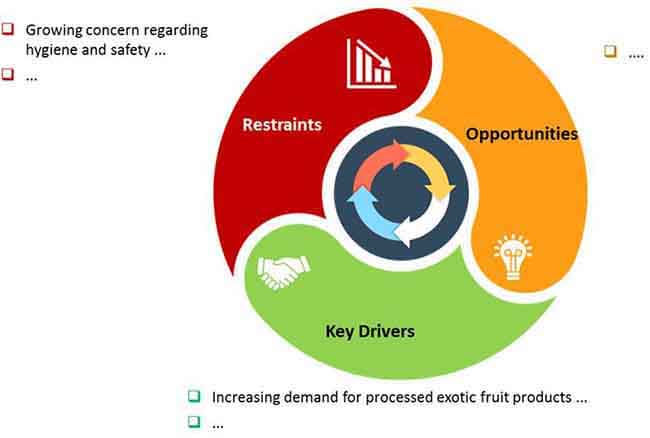
- The increasing demand for processed exotic fruit products is a key trend affecting the growth of the fruit processing equipment market.
- Emerging countries with an agricultural base are contributing to the growth of the global fruit processing equipment market due to their favorable climate condition.
- For instance, Ethiopia’s climate supports horticulture products such as citrus fruits, bananas, pineapples, avocados, passion fruits, mangoes, mandarins, guavas, papayas, and grapes. Ethiopia exports fruits to Europe and countries of the Middle East.
- Governments also provides incentives for investing in the fruit processing sector.
- Thus, Europe and the Middle East have ample growth opportunities for the expansion of the fruit processing equipment market.
- Vendors are engaged in research & development to improve the quality of processed fruit products by implementing several technologies. For instance, High Pressure Processing (HPP) technique is used to pasteurize fresh fruits by preserving the nutrients in the fruits.
Planning To Lay Down Future Strategy? Request Sample https://www.transparencymarketresearch.com/sample/sample.php?flag=S&rep_id=73853
Fruit Processing Equipment Market: Segmentation Analysis
- Based on application, the global fruit processing equipment market can be divided into fruit juice, fruit powder, and fruit squash; canned fruits; frozen & dried fruits; jams & jellies; and other related applications.
- The fruit juice, fruit powder, and fruit squash segment is a prominent application area of fruit processing equipment. This application segment accounted for major market share in 2018. The segment is projected to maintain its dominance in the global fruit processing equipment market throughout the forecast period.
- The fruit juice, fruit powder, and fruit squash segment is likely to gain popularity among consumers. Thus, this application segment is projected to grow significantly over the forecast period due to its increasing consumption across the world.
North America to Lead the Global Market for Fruit Processing Equipment
- In terms of region, the global fruit processing equipment market can be divided into North America, Europe, Asia Pacific, South America, and Middle East & Africa
- North America accounted for major share of the fruit processing equipment market in 2018, followed by Europe and Asia Pacific.
- The fruit processing equipment market in North America is majorly impacted by the growing population, expansion of the fruit processing industry, and varieties of marketing strategies implemented by market players to meet the changing needs of consumers.
- Growing demand for canned fruits among people due to its concentrated flavor, increased shelf life, and ease of use is expected to drive the demand for fruit processing equipment in North America.
Curious? Request To Access Market Data Fruit Processing Equipment Market
Key Manufacturers Operating in the Market
The global fruit processing equipment market was moderately fragmented in 2018, with presence of multiple established players who have occupied prominent share in the market. They are engaged in research and development activities to launch innovative fruit processing equipment with advanced optical technologies. Key manufacturers operating in the global market are:
- Alfa Laval AB
- Bertuzzi Food Processing S.r.l.
- Bühler Holding AG
- FENCO Food Machinery s.r.l.
- JBT Corporation
- Turatti Group
More Trending Reports by Transparency Market Research –
Intelligent Transportation Systems (ITS) Market https://www.globenewswire.com/news-release/2019/07/24/1887310/0/en/Intelligent-Transportation-Systems-ITS-The-March-Towards-Congestion-Free-Roads-Says-TMR.html
Comments
Post a Comment