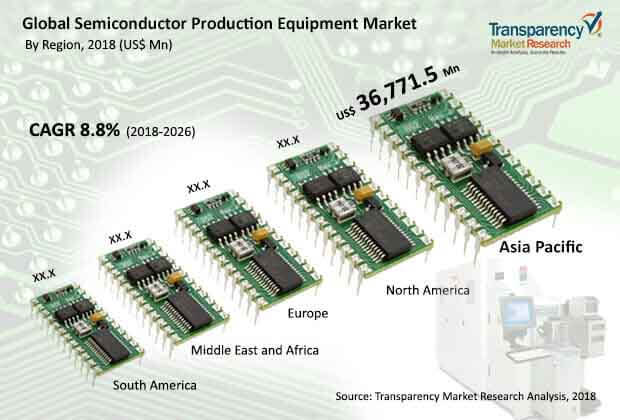
According to a new market report published by Transparency Market Research titled “Semiconductor Production Equipment Market – Global Industry Analysis, Size, Share, Growth, Trends and Forecast, 2018 – 2026,” the global semiconductor production equipment market is expected to reach a value of US$ 92,116 Mn by 2026. In terms of value, the market is estimated to expand at a CAGR of 8.8% during the forecast period from 2018 to 2026. In terms of volume, the market is expected to reach 130.8 thousand units at a CAGR of over 6.6% by 2026.
The Asia Pacific semiconductor production equipment market is projected to have the highest growth during the forecast period. Semiconductor industry saw an exponential growth owing to increased demand for semiconductors in diverse applications. Accordingly, there has been a spike in sales growth of semiconductor production equipment.
Planning To Lay Down Future Strategy? Request Sample https://www.transparencymarketresearch.com/sample/sample.php?flag=S&rep_id=19646
Semiconductor companies are partnering with automotive industry players to come up with advanced semiconductor solutions in Advanced Driver Assistance Systems (ADAS) technology. Industry leaders are introducing new and advanced equipment to cater to diversifying needs of automotive semiconductor requirements. For instance, Canon, Inc. has commenced with the sales of new 200 mm wafer equipment for i-line and KrF lithography equipment. This equipment is expected to mass-produce logic, memory, and image sensor devices necessary for automotive technologies.
Additionally, companies are increasingly investing on the construction of new fabs. For instance, companies such as Intel, Micron, Toshiba, and Global Foundries have increased their fab investments since 2017. Additionally, South Korea is witnessing a surge in fab investments from Samsung as it is expected to increase its investment from US$ 8 Bn to US$18 Bn in 2017-2018. Furthermore, SK Hynix also invested around US$ 5.5 Bn in fab equipment.
Curious? Request To Access Market Data Semiconductor Production Equipment Market
By geography, Asia Pacific region is expected to continue its dominance in the semiconductor production equipment market in 2017 with more than 75% market share. Across Asia Pacific region, countries such as China, Taiwan, Korea, India, Japan, and India hold more than 90% market share in the semiconductor production equipment market. The companies serving this region are increasingly investing on new construction of fabs and R&D spending in the semiconductor equipment market. Industry concentration of players across the value chain is also consequently high in this region.
The top companies considered while studying this report for the semiconductor production equipment market are Applied Materials, Inc., ASML Holding N.V., Lam Research Corporation, KLA-Tencor Corporation, Advantest Corporation, Teradyne Inc., Canon Inc., Nikon Corporation, Hitachi, Ltd., Screen Holdings Co., Ltd., Tokyo Electron Limited, and Hitachi, Ltd. These companies cover above 75% of the global semiconductor production equipment market.
More Trending Reports by Transparency Market Research –
Intelligent Transportation Systems (ITS) Market https://www.globenewswire.com/news-release/2019/07/24/1887310/0/en/Intelligent-Transportation-Systems-ITS-The-March-Towards-Congestion-Free-Roads-Says-TMR.html
Comments
Post a Comment