HVAC Motor Market: Introduction
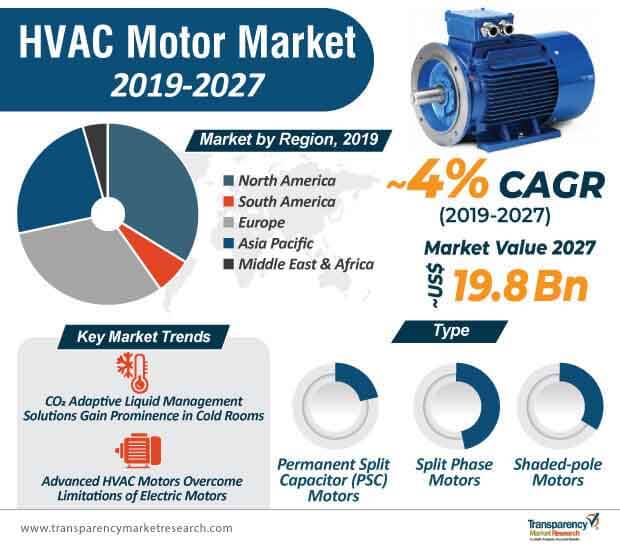
According to a new market report pertaining to the global HVAC motor market published by Transparency Market Research the global HVAC motor market is anticipated to reach volume of 10,116 thousand units by 2027. The HVAC motor market is projected to expand at a CAGR of ~4% from 2019 to 2027 in terms of sale. Growth of the HVAC motor market can be attributed to integration of smart technology into HVAC motors, which has triggered their demand globally. Over the forecast period, North America is anticipated to emerge as the leading HVAC motor market, followed by Europe and Asia Pacific.
Rising Production of Automobiles Drives HVAC Motor Market
The surge in demand for efficient machine control in the automotive industry due to extensive adoption of efficient HVAC motors is one of the important factors accelerating the demand for HVAC motors across the globe. Additionally, HVAC motors are widely used in automobiles to support HVAC systems in a vehicle, such as for defrosting the windows, regulation of internal temperature, as well as engine cooling which are main elements of automobiles.
Planning To Lay Down Future Strategy? Request Sample https://www.transparencymarketresearch.com/sample/sample.php?flag=S&rep_id=73711
Furthermore, growing advancement and increasing production of passenger cars across the world is fueling the demand for HVAC motors, as these motors are used in automobiles in some common applications such as air conditioning blowers and fan motors.
HVAC Motor: Market Segmentation
The global HVAC motor market has been segmented in terms of type, speed, distribution channel, industry, and region. Based on type, the HVAC motor market has been classified into permanent split capacitor (PSC) motors, split phase motors, and shaded-pole motors. Among types, the split phase motors segment dominated the global HVAC motor market in 2018.
Based on speed, the HVAC motor market has been categorized into low-speed motors (less than 1,000 rpm), medium-speed motors (1,001-25,000 rpm), and high-speed motors (25,001-75,000 rpm). In terms of distribution channel, the HVAC motor market has been categorized into direct sales (OEM), and indirect sales. In terms of industry, the HVAC motor market has been classified into automotive, food & beverages, oil & gas, petrochemical, agricultural, marine, manufacturing plants, aerospace & transportation, and others (power plants and mining).
Curious? Request To Access Market Data HVAC Motor Market
HVAC Motor Market: Regional Outlook
In terms of region, the global HVAC motor market has been segmented into North America, Europe, Asia Pacific, Middle East & Africa, and South America. North America is anticipated to dominate the HVAC motor market during the forecast period. The U.S. is estimated to hold a notable share of the market in the North America region and the market in the country is projected to expand at a CAGR of 6.5% during the forecast period, due to a rise in adoption of HVAC motors in industrial, transportation, and commercial sectors.
Asia Pacific led the global HVAC motor market, accounting for a substantial share in 2019, with China, India, and Japan being the major markets in the region. The HVAC motor market in Middle East & Africa, Europe, and South America is also projected to increase moderately during the forecast period.
HVAC Motor Market: Competition Dynamics
The research study includes profiles of leading companies operating in the global HVAC motor market. Key players profiled in the report include ABB, Rockwell Automation Incorporation, Nidec Corporation, Regal-Beloit Corporation, Johnson Electric Holdings Limited, Emerson Electric Corporation and W.W. Grainger, Inc.
More Trending Reports by Transparency Market Research –
Wireless Audio Devices Market https://www.globenewswire.com/news-release/2019/05/28/1853309/0/en/Wireless-Audio-Devices-Market-to-gain-revenue-worth-US-10-12-Bn-by-2024-Launch-of-Better-Functionality-and-Aesthetics-to-Boost-Sales-of-Wireless-Audio-Devices-TMR.html
Comments
Post a Comment