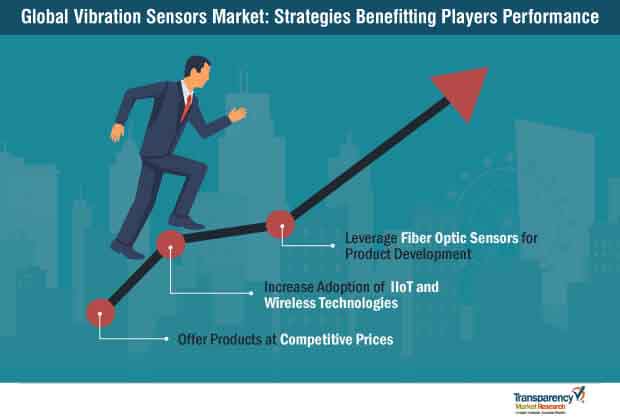
According to a new research report published by Transparency Market Research (TMR) , the global vibration sensor market is expected to reach a value of ~ US$ 4.5 Bn by 2027, expanding at a CAGR of ~ 5% from 2019 to 2027. According to the report, the global vibration sensor market is likely to continue to be influenced by a range of macroeconomic and market-specific factors in the next few years. In terms of demand, Asia Pacific is projected to continue to lead the global vibration sensor market, with the vibration sensor market in the region expanding at a CAGR of ~ 5% between 2019 and 2027.
Global Vibration Sensor Market: Overview
- The last few years have seen significant rise in the awareness about predictive maintenance as well as safety in various high growth regions such as North America, Europe, and Asia Pacific.
- This is attributable to the increase in the adoption of vibration sensors in several industry verticals. Vibration sensors are used to measure and analyze parameters such as linear velocity, displacement, and acceleration. These parameters are required to monitor machine health that further improves productivity as well as reduces maintenance cost. Also, the use of vibration sensors is increasing as machine condition monitoring plays an important role in improving the performance of machines. These factors have driven the demand for vibration sensors in Asia Pacific. Increase in the demand for vibration sensors in high growth regions is projected to directly increase the growth of the global vibration sensor market.
Planning To Lay Down Future Strategy? Request Sample https://www.transparencymarketresearch.com/sample/sample.php?flag=S&rep_id=69041
Accelerometers Hold a High Share in the Global Vibration Sensor Market
- The accelerometers segment was dominant, holding 71.46% share of the global vibration sensor market in 2018. The segment is anticipated to continue its dominance throughout the forecast period in the vibration sensor market.
- Piezoelectric type accelerometer vibration sensors have large demand within various industry verticals.
Processing Industry Holds the Leading Market Share
- The processing industry segment is anticipated to be a prominent segment in the global vibration sensor market throughout the forecast period.
- The segment is projected to expand at a CAGR of ~ 5% from 2019 to 2027. This is primarily due to the high adoption of vibration sensors in processing industries such as food & beverages, metal & mining, and paper & pulp.
Asia Pacific to be a Highly Lucrative Market for Vibration Sensors
- In terms of geography, the global vibration sensor market has been segmented into North America, Europe, Asia Pacific, the Middle East & Africa, and South America. Asia Pacific dominated the global vibration sensor market, holding 33.08% of the market share in 2018.
- The market in Asia Pacific is expected to expand at the CAGR of ~ 5% during the forecast period.
- Growth of the vibration sensor market in Asia Pacific is attributable to the rising demand for vibration sensors for use in a wide range of applications in the region. These include condition monitoring, machine monitoring, industrial monitoring, medical instrumentation, sports diagnostic equipment, and military applications where wide bandwidth, small form factor, low power, and high performance are critical.
Request To Access Market Data Vibration Sensor Market
Vibration Sensor Market: Competition Landscape
- With the objective of business expansion, several players operating in the global vibration sensor market are expanding their offerings through strategic mergers and acquisitions as well as partnerships. Furthermore, an increasing number of players are spending significantly on R&D activities to develop innovative and technologically-advanced vibration measurement solutions.
- Some of the prominent players operating in the global vibration sensor market are Honeywell International, Inc., TE Connectivity Ltd, Robert Bosch GmbH, ASC GmBH, MTI Instruments Inc., Keyence Corporation, Safran Colibrys SA, Hansford Sensors Ltd, National Instruments Corporation, and Analog Devices, Inc.
Comments
Post a Comment