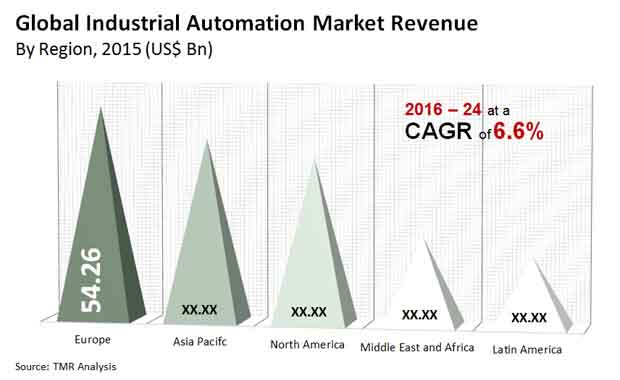
The global industrial automation market exhibits a highly cutthroat competition mainly due to the presence of innumerable players, observes Transparency Market Research based on a newly published report. The fragmented nature of this market’s vendor landscape depicts most players integrating their products with advanced technologies. With an increasing demand for industrial-grade products occurring in almost every sector, a high requirement for automation that can help mass produce commodities is being felt all over the globe. This has caused a spike in the number of players entering the industrial automation market, which is certainly expected to increase the competitive intensity during the upcoming years.
Developing products that deliver functional transformation and commercial excellence is expected to be a key strategy adopted by most players working in the global industrial automation market to stay ahead in the competition. Key players working in this market are: Toshiba Machine Corporation Ltd., Rockwell Automation, Inc., FANUC Corporation, Yaskawa Electric Corporation, Yokogawa Electric Corporation, Emerson Electric Company, BB Ltd., Honeywell International Inc Mitsubishi Electric Corporation, Voith GmbH, and General Electric Company, among several others.
Planning To Lay Down Future Strategy? Request Sample https://www.transparencymarketresearch.com/sample/sample.php?flag=S&rep_id=10868
According to experts from Transparency Market Research, the global industrial automation market had gained revenue worth US$182.64 bn in 2015, which is further expected to grow up to US$352.02 bn by the end of 2024. This growth is projected to occur at a handsome CAGR of 6.6% during the forecast period from 2016 to 2024.
Demand for Fast Production Capacity Creates Need for Rampant Industrial Automation
A rapidly increasing demand for fast production capacities is primarily driving the global industrial automation market. Such a high demand mainly exists in terms of automotive assemblies, telecom networks, aircrafts, heat treating boilers and ovens, chemical plant machinery, steering and ship stabilization, and other machinery systems. Moreover, several companies are pouring large sums of money to facilitate research and developmental processes regarding industrial automation. This too has been responsible for propelling growth in the global industrial automation market.
Various industrial segments are adopting automation systems to reduce labor burden, consequently making the market grow at a respectable pace. Automation also brings into picture the implementation of various innovative solutions, compared to manual processes. All these factors are certainly expected to fuel the global industrial automation market, and make it thrive spectacularly and better than current times during the forthcoming years.
Request To Access Market Data Industrial Automation Market
Lack of Awareness Regarding Automation Benefits Stunts Growth
However, steep costs required to set up systems for machinery production, as well as expensive research and development activities undertaken for the same is greatly hampering the global industrial automation market’s growth. High installation and maintenance expenses are discouraging small-scale plants and industries to avoid automation completely.
Moreover, lack of awareness regarding benefits of automation in several regions too is posing as an obstacle to the market in several developing and emerging economies. Nevertheless, several end user segments such as pharmaceuticals, water management, chemicals, electronics, and food and beverages, are witnessing a rampant need for automation. This is certainly expected to soon reduce the effects of restraints affecting the global industrial automation market.
Comments
Post a Comment