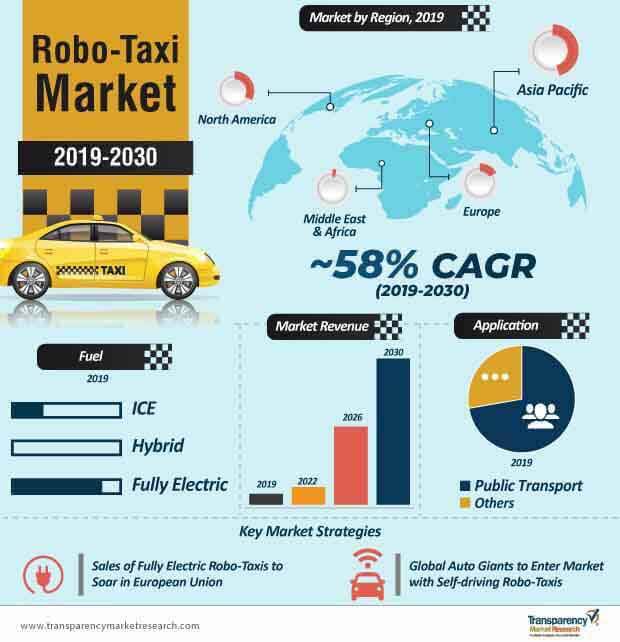
Transparency Market Research has published a new report on the robo-taxi market for the forecast period of 2019–2030. According to the report, the global robo-taxi market is projected to reach a value of ~US$ 15 Bn by 2030, expanding at a CAGR of ~58% during the forecast period of 2019 to 2030.
Global Robo-Taxi Market: Overview
- According to the report, the global robo-taxi market is likely to be driven by the demand for reduction in the total cost of ownership by ride-hailing companies.
- The emergence of new business models, such as 'mobility as a service', are offering significant opportunities to automakers instead of one-time vehicle sales. Automakers are trying to introduce autonomous vehicles in taxi services to improve consumer service, offer ride-service at lower costs, and lower the operating cost of the service.
- Key players such as Uber Inc., Waymo, Baidu, and Easy Mile are successfully conducting pilot projects on robo-taxis, and are expected to lead the global robo-taxi market.
Planning To Lay Down Future Strategy? Request Sample https://www.transparencymarketresearch.com/sample/sample.php?flag=S&rep_id=65897
Expansion of Global Robo-Taxi Market
- Robo-taxis reduce the cost of ownership of a fleet operator by 30% to 50%. Radical shift from private ownership of vehicles to shared mobility has evolved the mobility industry, making it imperative for ride-hailing companies to offer services at competitive costs.
- The robo-taxi market is at the development stage, with expansion likely to occur post 2025.
- The U.S. and China have favorable regulatory frameworks to test autonomous vehicles. Several pilot projects are being carried out in these countries, and are expected to lead the global robo-taxi market.
Based on application, the global robo-taxi market has been bifurcated into public transport and others. The rising adoption of autonomous vehicles in ride-hailing services and shared mobility is projected to drive the public transport segment, and subsequently, the robo-taxi market. Robo-taxis are also being utilized to commute shorter distance within business parks, universities, industrial sites, amusement parks, and residential townships.
Request To Access Market Data Robo-Taxi Market
Based on vehicle, the global robo-taxi market has been classified into cars and shuttles. The cars segment is anticipated to hold a dominant share of the global robo-taxi market, with companies such as Uber Inc., Waymo, Baidu, and Pony.ai launching robo-taxis for the markets in North America and Asia Pacific. The shuttles segment holds a significant share of the robo-taxi market, as autonomous vehicles are being adopted to serve geo-fenced areas such as industrial parks, airports, and universities.
Regional Analysis of Global Robo-Taxi Market
- In terms of region, the global robo-taxi market has been segregated into North America, Europe, Asia Pacific, Middle East & Africa, and Latin America. North America held a prominent share of the robo-taxi market in 2018. It is anticipated to dominate the global market during the forecast period. Favorable regulatory framework, sustained investments in infrastructure, consumer acceptance of autonomous driving, and the presence of key players in the U.S. is driving the robo-taxi market in North America.
Prominent players operating in the global robo-taxi market include Waymo LLC, Aptiv, NAVYA, Uber Technologies, GM Cruise, EasyMile, MOIA, Baidu, Tesla, DiDi, and AB Volvo.
Comments
Post a Comment