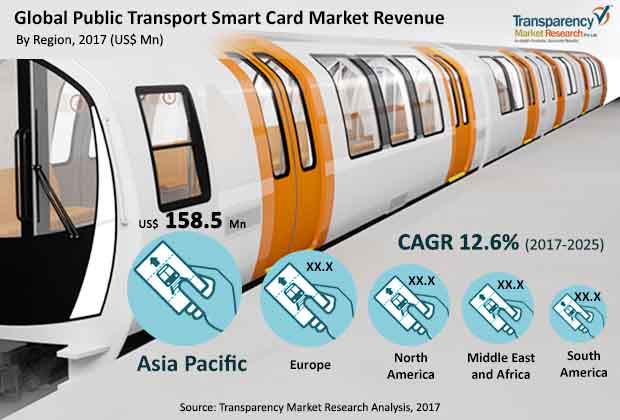
In light of spiking rivalry, the leading players in the global public transport smart card market are experimenting with diverse strategies to gain competitive strength. In a recent study, Transparency Market Research (TMR) has highlighted strategic collaborations witnessed in the past few years as some of the key moves by the market players to emerge stronger. Meanwhile, larger companies in the global public transport smart card market are keen on acquiring smaller players to expand their regional footprint. In addition, the companies operating in the global public transport smart card market are likely to distinguish their product and service offerings through unique sales proposition. This will help them achieve a unique brand identity, subsequently emerging as a stronger player in the global public transport smart card market.
Strategies that companies experiment with are bound to influence the prevailing trends in the global market. According to TMR, the global public transport smart card market will surge at 5.6% between 2017 and 2025. By the end of 2025, the global public transport smart card system is likely to reach US$89,862.2 mn. The market was valued at US$55,000 mn in 2016. Occupying nearly 45% of the global market, North America emerged dominant in 2016. The region’s growth in the global sphere will be backed by the presence of a highly structure healthcare industries. Based on technology type, the clinical chemistry segment held lead in 2016, holding nearly 25% of the global public transport smart card market.
Planning To Lay Down Future Strategy? Request Sample https://www.transparencymarketresearch.com/sample/sample.php?flag=S&rep_id=38051
Global Market Derived Significant Benefit from Large-scale Implementation in Emerging Nations
When smart card was introduced, the primary aim was to simplify public transport ticketing, in turn making transport system more efficient. In the last couple of years, electronic smart cards have emerged as more efficient alternatives for users to pay and access transport services. The smart card technology has been around for quite some time and so have the implementations with smart cards. However, in the transport industry, the early pioneering trials resulted in much talked about failures. Notwithstanding this, by the late 1990s, the transport sector in developed nations realized the potential benefits of adopting smart-card ticketing. Gradually, large scale ticketing schemes were implemented in Asia. This enabled the global public transport smart card market gain significant momentum in the past.
It is not only passenger who benefits from the smart ticketing systems. Benefits are also derived by local transport authorities and central government. The advent of technological advanced ticketing schemes has made possible diverse applications of smart card in the transport sector. This in turn has amped up the installation of advanced fare payment systems, thereby, enabling the global public transport smart card market gain significant impetus. These smart cards can be used for various fare structure, which is identified as a chief market driver.
Curious? Request To Access Market Data Public Transport Smart Card Market
High Cost Incurred on Migrating Smart Cards May Hamper Growth
On the downside, migration of smart cards may incur high investment. This factor can restrain the market’s trajectory to an extent. Besides this, technical challenges with regards to using smart cards may hamper the market’s growth in the coming years. Nonetheless, recent forecasts suggest that the technology will penetrate further in developing and underdeveloped countries in the coming years. Spurred by novel opportunities, the global public transport smart card market is likely to showcase immense growth during the course of the forecast period.
More Trending Reports by Transparency Market Research –
Automotive Electronics Control Management Market https://globenewswire.com/news-release/2019/02/19/1734118/0/en/Automotive-Electronics-Control-Management-Market-Projected-to-Surpass-US-80-Bn-by-2026-States-TMR.html
Comments
Post a Comment