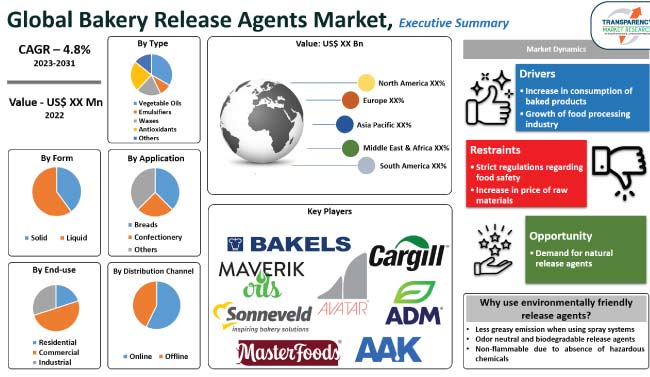
According to a new market report published by Transparency Market Research titled “Bakery Release Agents Market – Global Industry Analysis, Size, Share, Growth, Trends, and Forecast, 2018 - 2026,” the global bakery release agents market is expected to reach a value of US$ 597.3Mn by 2026. In terms of value, the market is estimated to expand at a CAGR of 5.2% during the forecast period from 2018 to 2026. In terms of volume, the market stood at around 630.4 thousand tons in 2017. The North American bakery release agents market is projected to have the highest growth during the forecast period.The market witnessed considerable growth due to increased demand for bakery products by manufacturers, supported by the population demand.
The bakery release agents market is growing primarily due to the increased consumption of bakery products supported by the ever increasing population in developing countries. Out of the global network of release agents, the U.S. stands at first position in terms of demand for these products. The demand for bakery release agents in the U.S. and other countries are influenced by the rise in consumption of bread. Bread being the highest consumed bakery product, has the largest application of bakery release agents. On the other hand, one of the main challenging factors affecting this industry is the cost of ingredients such as vegetable oils. However, the bakery release agents market is expected to overcome this challenge by the use of cost effective organic ingredients.
Planning To Lay Down Future Strategy? Request Sample https://www.transparencymarketresearch.com/sample/sample.php?flag=S&rep_id=48615
In 2017, based on form of these agents, the liquid segment accounted for market value of about US$ 184.9 Mn in the global bakery release agents market. Liquid bakery release agents are widely manufactured and consumed globally due to its properties that result in a smooth texture of the products, and easy application. In terms of product type, globally the pastries segment is expected to expand at the highest CAGR of about 5.4% in terms of value, followed by bread which accounted for the largest market share.
Bread being the highest consumed bakery product, has the largest application of bakery release agents. The use of a low-viscosity, high-performance release agent is generally recommended for these baked products.These factors are expected to showcase growth potential for bakery release agents in bread. In terms of ingredients, the vegetable oil segment is anticipated to account for the largest market share in terms of value. Vegetable oils affect the polymerization/ resinification and oxidation stability in bakery product processing.
Request For COVID19 Impact Analysis Across Industries And Markets - Bakery Release Agents Market
Vegetable oils such as soybean oil, palm oil, and others are widely used by bakery products manufacturers. This factor is primarily responsible for the major share of vegetable oils in the bakery release agents market. Furthermore, in terms of end-use, the industrial and commercial segment is anticipated to account for the largest share and is expanding at a higher CAGR than the residential segment.The industrial utility of bakery release agents is categorized by various products such as baked goods, biscuits, and breakfast cereals. By geography, North America region is expected to continue its dominance in the bakery release agents market with more than 35% market share in 2017. Across North America, the U.S held 41% market share in the bakery release agents market in the year 2017.
The top companies considered while studying this report for the global bakery release agents market are Archer Daniels Midland Company, Mallet & Company, Inc., Masterol Foods Pty. Ltd., Cargill, AAK AB, Avatar Corporation, Sonneveld Group B.V., British Bakels Ltd., Lasenor Emul, S.L., and Maverik Oils, L.L.C.
More Trending Reports by Transparency Market Research –
Comments
Post a Comment