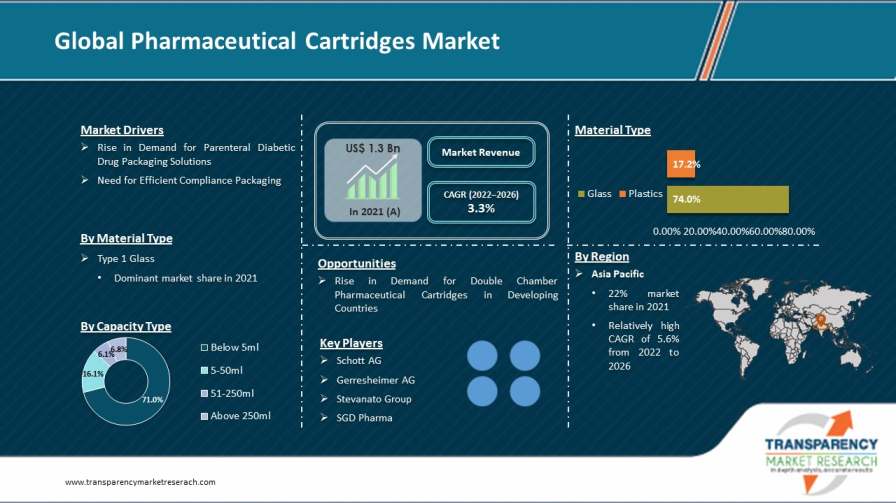
Glass manufacturers and providers of pharmaceutical injectables in the pharmaceutical cartridges market have been keen on widening the array of their drug delivery systems to expand their footprints. Innovations pivot on the adoption of new technologies, such as multi-pass engineering technologies, and materials sciences. Players in the pharmaceutical cartridges market are leaning on the production of high-quality injectables for wide spectrum of patient populations. They have reaped large revenue prospect from the demand for better drug delivery systems among diabetics, for instance.
The global pharmaceutical cartridges market is estimated to rise at a CAGR of 3.2% during 2018 – 2026, vis-à-vis revenue.
Planning To Lay Down Future Strategy? Request Sample https://www.transparencymarketresearch.com/sample/sample.php?flag=S&rep_id=39854
Glass a Preferred Material but Providers of Injectable Solutions Focus on Polymers
Among the various material types used for making pharmaceutical cartridges glass has remained by far the most prominent. Their high hydrolytic resistance and chemical resistivity have benefitted manufacturers in the pharmaceutical cartridges market. Several of them have been successful in unveiling glass pharmaceutical cartridges with excellent dimensional tolerance, bagging compliance with international standards by the FDA. Type 1 borosilicate glass among all types has been a preferred material for manufacturers of glass pharmaceutical cartridges.
However, recent consumer trends in the pharmaceutical cartridges market suggest that the degradation of glass over the years of their use might hamper the injectable drugs integrity. Further, their transportation needs substantial caution. Advances in polymer-based composites have enabled them to utilize different copolymers, thereby expanding the scope of the manufacturers in the pharmaceutical cartridges market. These have catalyzed the demand for plastics pharmaceutical cartridges. On the other hand, manufacturers and developers of pharmaceutical injectables are focusing on improving the surface properties of glass and plastic materials, including glass.
Request For COVID19 Impact Analysis Across Industries And Markets - Pharmaceutical Cartridges Market
Players in the pharmaceutical cartridges market are aiming at product customization to garner competitive edge over others. A case in point is efforts to advance internal siliconization and shape optimization.
Emerging Markets Evolve on Back of Demand for Better Drug Delivery Systems
Growing demand for safe and reliable drug delivery systems for diabetic populations is one of the key factors driving developments in the pharmaceutical cartridges market. Efforts of industry players to incorporate automated packaging processes are also boosting the market prospects. Further, clinicians have been expanding their drug delivery systems with the advances being made in sterilization technologies.
Among the various regions, the North America pharmaceutical cartridges market has made its mark prominent on the global scale. Meanwhile, both the Middle East and Africa are emerging as promising regions. Their evolution gained robust force on the back of advances made in pharmaceutical packaging. Demand for technologically-advanced drug delivery systems for both clinicians and patient population in Asia Pacific health care has reinforced the potential for the adoption of new line of products in the pharmaceutical cartridges. Manufacturers in recent years have set their sights on expanding their footprints in the ASEAN region and India. The vast untapped opportunities has attracted them to serve the unmet need for patient populations.
More Trending Reports by Transparency Market Research –
Process Spectroscopy Market https://www.globenewswire.com/news-release/2019/08/20/1904315/0/en/Demand-for-Better-Manufacturing-Process-to-Surge-the-Growth-of-Process-Spectroscopy-Market-Reports-Transparency-Market-Research.html
Comments
Post a Comment